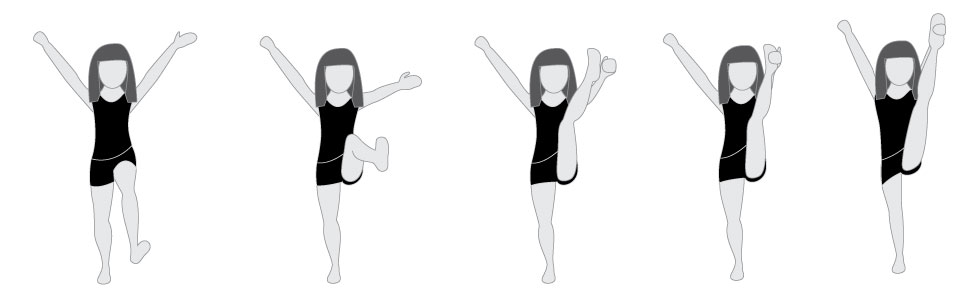
Stretching
An anonymous medical professional that was interviewed said, "the most efficient way to prevent injury in any sport is to stretch, with a sport about flexibility such as baton and gymnastics it is even more important." Always take time to warm up and stretch. Research studies show that cold muscles are more prone to injury. Warm up with jumping jacks, or running or walking in place for three to five minutes. Then slowly and gently stretch, holding each stretch for 30 seconds.
ACL
Single Leg Bridge: This exercise is designed to strengthen the hamstrings and glutes, which help maintain upper- and lower-leg alignment along with the ACL. Its single-leg nature is important for eliminating strength differences between the left and right leg, reducing the chance of injury from an imbalance.
Single Leg Reach: This is an important balance exercise, aiding in hip stability and alignment of the upper and lower leg. Keeping your hip, knee and ankle in line is essential for preventing your knee from collapsing inward when you land from a jump.
Vertical Jumps: This exercise is designed to address knee alignment during deceleration. An inward (valgus) collapse of the knees is a primary predictor of non-contact ACL injuries.
Dislocated Knee
Leg Press: This exercise builds quad strength with no impact and little stress on the joint. You can work your legs together or separately for an additional challenge.
Heel Raises: To finish building strength around your knee, work your calves with heel raises. Find a box or a stair and stand with your heels hanging off. Then pump your feet up and hold for one second before lowering.
Hamstring Stretch: Place one foot on a waist-high stationary object like a chair and slowly lean forward to feel a stretch in your hamstring. Keep your back straight to avoid injury.
Shoulder Pain
Cross Arm Stretch: Improve the flexibility of the muscles in the back of the shoulder and back of the shoulder joint capsule.
Sleeper Stretch: Improve the flexibility of the muscles in the back of the shoulder and back of the shoulder joint capsule.
Hip
Piriformis Stretch: Laying on your back, maintain a neutral spine position. Bend one leg up and across your body, use your arms to pull your knee and foot into your chest, keeping your shoulders square.
Hip Flexor Stretch: Stand in a wide lunge with your back foot on demi pointe. Keep your hips/pelvis either straight or slightly pushed forward. Bend your front knee slowly until you feel a stretch in the front of the hip of your back leg.
Internal Rotation Stretch: Lay down on your back. Keep spine in neutral and move your feet away from your body keeping your knees together. You should feel a gentle stretch on the outside of your hips. If you feel pain in your groin, stop.
Work Cited
Anonymous Medical Professional. Personal Interview. 8 Oct. 2017
N.A. N.D. “The Evidence.” Twirling Physical Therapy, tips4twirlers.weebly.com/the-evidence.html.
Joyce, David, and Daniel Lewindon. Sports injury prevention and rehabilitation: integrating
medicine and science for performance solutions. RoutledgeTaylor and Francis Group,
2016.
